How to Use Price Anchoring in Content to Boost Quit-Smoking Course or Product Conversion Rate
# How to Use Price Anchoring in Content to Boost Quit-Smoking Course or Product Conversion Rate
In mid-March 2024, I was sitting in a co-working space near Nanshan Science Park in Shenzhen, staring blankly at my livestream backend: a long recommendation article about "nasal-inhalation smoking cessation aid + 21-day behavior course" had 12,000 reads, 47 DM inquiries, but only 3 actual payments. Average order value: 398 RMB. That same week, a competitor's article with almost identical structure had similar readership but sold over twenty units. I pasted both articles line by line into a comparison table. The difference wasn't in writing quality — it was in **the first number that appeared**. They wrote "comparable high-end solutions on the market range from 1200–1800 RMB" first, then "this package only 398". I went straight to "limited time 398". My readers had no reference point in their minds.
Price anchoring isn't a copywriting trick — it's a cognitive bias repeatedly validated in behavioral economics: people rarely judge "expensive or cheap" in a vacuum. They grab the first reference point they see, then make relative comparisons. In the classic experiments by Tversky and Kahneman, random numbers distorted subsequent valuations. In sales scenarios, **the first price number is the anchor**. All subsequent "worth it / not worth it" judgments revolve around it.
Below I'll write in the order of "how to embed anchors in content → how to pair comparison/scarcity/authority → where the boundaries are → the real pitfalls I've stepped into", so you can directly adapt it for your quit-smoking course or product copy.
1. The Anchor in Content Is Not Just "Strikethrough Price"
Many people think anchoring means "original price 999, now 399". A strikethrough price is one type of anchor, but in **content-based sales** (WeChat official accounts, Xiaohongshu, Zhihu, livestream scripts, long-form landing pages), anchors often appear much earlier and aren't necessarily the product's own price tag.
Four common types of "content anchors":
- **Cost anchor**: One year's cigarette money.
One pack a day at 25 RMB, roughly 9,000 RMB a year; ten years is 90,000+. Then you place a 398–1280 course or device package, and the reader's mental ruler has already shifted from "a few hundred" to "relative to ten years of cigarette money."
- **Failure cost anchor**: The sunk cost of repeated quit attempts.
Tried two boxes of patches, three boxes of gum, subscribed to a quit-smoking app, treated friends to dinner as a pledge — all of it added up may cost more than a systematic solution, yet never closed the loop. Write down "what you've already spent", then present your product price — the anchor is **regret**, not an inflated original price.
- **Competitor/industry anchor**: Hospital smoking cessation clinics, offline personal training, high-end wellness programs.
In first-tier cities, smoking cessation interventions or coaching at some institutions can cost thousands. Objectively write the range in your content (preferably with a source or "according to public pricing"), and your mid-range solution will feel "adequate and not absurd."
- **Option anchor (decoy)**: Intentionally place a clearly overpriced high-tier option to make the middle option look good.
For example: device only 299; device + recorded course 398; device + recorded course + group coaching + review 1280. Most people will gravitate toward the middle — not because it's the best, but because it's the "safest" relative to the two ends.
**My clear opinion**: In the quit-smoking category, **cost anchor + failure cost anchor** are more durable than an inflated "original price 1999". Smokers are extremely sensitive to "how much per day" and extremely insensitive to "the merchant's self-written original price." The anchor should connect to the reader's real-life finances, not to the arbitrary strikethrough price you type into your backend.
2. Comparison: Let the Reader Do the Math
Comparison is the "calculation process" of anchoring. Without comparison, the anchor is just an isolated number.
2.1 Time comparison: Match "one-time payment" against "daily smoking"
Write clearly:
- Take the reader's common cigarette price (local mid-range, e.g., 20–30 RMB/pack).
- Calculate 30-day, 90-day, 365-day cigarette expenses.
- Divide the course/product total by days, landing at "cut half a pack a day and it's covered."
In May 2024, I revised a sales script for a private traffic conversion in Hangzhou. The original version only said "package 598". The revised version added three lines:
Based on Hangzhou's common 22 RMB/pack, 1 pack per day:
30-day cigarette cost ≈ 660 RMB;
This package is 598, equivalent to less than one month's cigarette money, and the goal is to save subsequent months' cigarette expenses.
That same week, with similar traffic, the inquiry-to-payment conversion rate went from about 4.1% to about 7.6% (small sample: ~800 impressions, payments went from 5 to 9). These numbers shouldn't be treated as industry truth, but they illustrate: **comparison rewrites price from "expense" to "replacement of an existing expense."**
2.2 Plan comparison: Three tiers, not two
Two tiers easily become a tug-of-war between "expensive vs cheap"; three tiers make the "middle is most reasonable" compromise more apparent.
A structure I've actually used (adjust numbers based on your costs):
| Tier | Content | Price | Role in content |
|---|---|---|---|
| Trial tier | Device or intro course | 199 | Anchor "minimum tryable" |
| Main tier | Device + 21-day course + community | 498 | The sales position lifted by the high anchor |
| Coaching tier | Main + 1-on-1 review ×4 | 1498 | High anchor + authority source |
Don't secretly put the worst service in the main tier; otherwise, negative reviews will backfire on all anchors. Decoys can be "expensive" but not "fake."
2.3 Boundaries of comparison
- **Never fabricate an "original price" that was never sold**. Advertising laws and platform rules are getting stricter on fake original prices; readers are also getting better at searching historical prices.
- **Never make medical efficacy part of price comparison**. For example, "spend 500 to avoid one lung cancer chemo session" — fear-based comparison may boost clicks short-term, but destroys trust long-term and carries high compliance risk. Quit-smoking content should stay within lifestyle and supportive aids, not replace medical treatment.
- **Comparison objects must be homogeneous**. Forcing your "recorded course" against a "top-tier hospital smoking cessation clinic + prescription drugs" makes professional readers immediately see the bait-and-switch.
3. Scarcity: Real Windows, Not Fake Countdowns
Scarcity changes **decision speed**, not the perception of price itself; it's often paired with anchoring: the anchor makes it "seem worth it," scarcity makes them "decide now."
Effective scarcity in quit-smoking scenarios usually comes from:
- **Service capacity**: Coaching slots, group management bandwidth. For example, "only 30 slots with supervision this week, after that, recorded-only."
- **Batch rhythm**: 21-day camp has fixed start dates; miss it, wait for the next.
- **Real deadlines for bonuses or benefits**: Device trial samples, expert livestream Q&A sessions.
Ineffective scarcity:
- The page always shows "only 3 left."
- The countdown restarts from 15:00 when you refresh the page.
- "Last day ever" used for three months straight.
During 2023 Singles' Day, I ran a 48-hour flash sale for a quit-smoking community. The anchor was "annual coaching original structure 1860, deal price 860." The first 6 hours had great conversion; at hour 7, someone in the group said, "you guys had the same countdown last Singles' Day." Trust cracked right there. That afternoon, refund requests increased by 4. **The cost of fake scarcity isn't one lost sale — it's anchor failure: readers no longer believe any number you report.**
**Boundary**: Scarcity must be verifiable. If you write "slots," your backend must actually limit slots; if you write "camp start date," your calendar must actually have a start date. Better to monetize a bit slower than to let "time pressure" become the reader's memory of being deceived.
4. Authority: "Notarize" the Anchor, Don't Just Polish Yourself
Authority doesn't directly equal a high price. Its role is to make readers accept: **this reference frame is credible.**
Authority signals available in content (roughly ordered by credibility):
- **Mechanism explanation**: Nicotine dependence, behavior substitution, the difference between nasal-inhalation pathways and hand-mouth habits — explaining "why it's designed this way" is more useful than "expert recommended."
- **Process data**: Course completion rate, 7-day check-in rate, 30-day follow-up relapse-free rate — note the sample size and statistical method, acknowledge limitations.
- **Third-party**: Test reports, published patent information, partner institution names (must be verifiable).
- **Identity**: Physician, psychological counselor, long-term smoker turned quitter — personal stories have warmth but cannot impersonate medical conclusions.
Example of an authority-anchoring combined sentence:
In behavioral intervention research, the relapse rate with willpower alone is very high; putting "daily cigarette cost" together with "structured 21-day actions" is meant to let you use the money you're already spending to exchange for an executable replacement program. This round's main recommendation is 498, benchmarked against your own monthly cigarette expenditure, not a random original price we made up.
Note the last sentence: **actively dismantling the fake original price** actually strengthens authority. Readers want an honest ruler, not a performative discount.
**Boundaries**:
- In domestic marketing of quit-smoking products and courses, avoid promising "definitely quit" or "cure addiction."
- Don't fake papers, doctor endorsements, or user case studies.
- Excessive authority raises expectations; when expectations break, the "bargain feeling" from anchoring reverses into "being ripped off."
5. A Ready-to-Embed Content Structure
Below is the long-article framework I've been using steadily since the second half of 2024 (nasal device + course package scenario). Adjust the numbers for your use:
- **Life anchor within the first 80 words**
"If you're in Guangzhou, a mid-range cigarette is about X RMB/pack, one pack a day, one year adds up to…"
- **Failure experience ~150 words**
Patches, e-cigarettes, cold turkey — how much each cost, which day you relapsed.
- **Mechanism ~200 words**
What your product/course addresses (hand-mouth substitution, dose tapering, check-in prompting) and what it doesn't (severe tobacco dependence requiring medical care).
- **First price appearance: industry or cost first, then your price**
"Offline coaching typically ranges from X–Y; we do standardized content + group supervision, main recommendation Z."
- **Three-tier table**
Trial / Main / Coaching, with main tier labeled "best for most first-time systematic quitters."
- **One line of scarcity**
Real slot limit or camp start date.
- **Risk disclosure**
Individual differences, not a substitute for medical treatment, return/exchange policy.
- **Call to action**
Single button or single contact method — avoid letting three anchors side by side cause choice overload.
6. The Pitfalls I've Stepped Into and the Specific Numbers
**Pitfall 1: Anchor too high, readers bounce immediately**
In January 2024, one article started with "high-end private smoking cessation consultant from 6800 up" then "you only need 398." DMs flooded with "is this a scam?" When the gap between anchor and product is too large, the brain doesn't go to "bargain" — it goes to "must be a trick." Later I changed the high anchor to "annual cigarette cost 8000+" and "outpatient-level intervention in the thousands," and the skepticism dropped significantly.
**Pitfall 2: Only anchor price, not the outcome path**
For a while, conversion went up, but the course completion rate was only 31% (21-day camp, 120 enrolled, only 37 checked in 14+ days). Money collected, reputation lost. Anchoring solves **the relative value perception at the moment of purchase**, not delivery. I later forced the main tier to include "3 minimum daily actions + review checkpoints on day 7/14/21," and the completion rate returned to about 50% — still not perfect, but refunds and negative reviews decreased.
**Pitfall 3: Authority symbol overload**
At one point I put four or five "certificate icons" at the top of the article. The mobile screen was full of stamps. Reading completion rate dropped. After I cut down to just one clickable test report summary + one mechanism explanation, dwell time recovered. Authority is "one verifiable sentence," not "stamp density."
**Pitfall 4: Ignoring regional cigarette price differences**
Using "one pack 30 RMB" as the anchor nationwide made lower-tier market readers feel it was fake; using "15 RMB" made first-tier readers feel you didn't understand them. Now I write "multiply your usual pack price × 30" in the content and let the reader do their own math — the anchor is generated by the reader, which is more accurate than me forcing a national average.
7. Boundaries of the Three Techniques: A "Use / Stop" Table
| Technique | Use | Stop |
|---|---|---|
| Anchoring | Real costs, real industry ranges, real higher-tier options | Fake original prices, fear-based medical bills, incomparable luxury goods |
| Comparison | Same-dimension plans, daily cigarette cost, time conversion | Switching medical and consumer concepts, baselessly disparaging competitors |
| Scarcity | Batches, slots, benefit deadlines with backend consistency | Fake countdowns, perpetual "last day" |
| Authority | Mechanisms, verifiable data, compliant qualifications | Absolute efficacy claims, fake endorsements |
**My overall judgment**:
In quit-smoking courses and products, the correct use of content anchoring is — **help readers use the cigarette money and failure costs they're already paying to recalibrate the psychological price of "trying a systematic method once"**; not to stage a performance of "from 1999 down to 399." Comparison handles the math, scarcity handles batch rhythm, authority handles credibility. Of the four, **anchoring and comparison are the skeleton; scarcity and authority are the rhythm and lubrication**. If the skeleton is fake, the latter two will only accelerate the crash.
Conversion rate can be optimized, but repurchase and referral in the quit-smoking category depend almost entirely on: during those weeks when he stops smoking, did you actually support him? Price psychology makes people willing to start; delivery ethics make people willing to say a good word about you. Without either, the data won't go far.
8. Five Actions You Can Change Tonight
- Open your worst-converting piece of content and find where **the first price number** appears; if it's directly your selling price, insert a "reader's annual cigarette cost" or "failed attempt expenses" paragraph before it.
- Change two tiers to three, make the middle the main recommendation, and ensure the high tier is deliverable.
- Delete all countdowns that can't be verified in your backend.
- Downgrade efficacy claims to "supportive, behavioral aid, individual differences" — trade for compliance and long-term trust.
- Record for 7 consecutive days: impressions, inquiries, payments, refunds; change only the anchoring paragraph, keep everything else the same, and see if inquiry→payment moves. When the sample is under 50 orders, don't jump to conclusions.
Price is a signal and also a filter. Anchor too aggressively, and you attract people looking for a cheap deal who are prone to refunds. Anchor honestly, and you attract people who've done the math and are willing to follow through. In the quit-smoking business, I'd rather have the latter — even if the short-term conversion rate is two points lower.
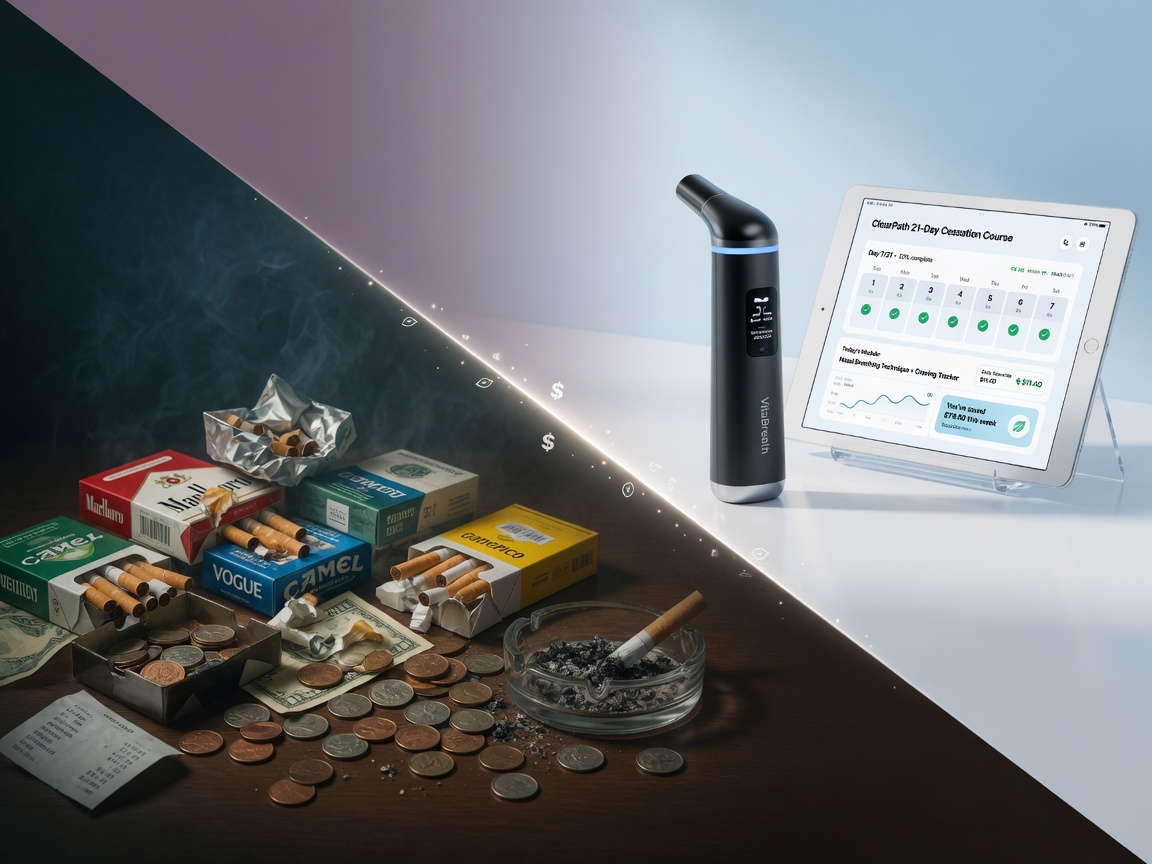
Without Anchoring
Directly state limited-time price, readers have no reference base, feel “expensive” or “not expensive” purely by instinct
With Anchoring
First establish a reference anchor like annual cigarette cost or failure cost in the reader’s mind, then quote product price — perceived value greatly increases